Thursday, 16 May 2013
Pursuing Purson
I, Melachi ibn Amillar, being of unsound mind and body, did attend the gig of Moss, Purson and Black Magician at the Underworld, Camden, on 15 May 2013. The first band played a slowish crushing processional metal with high synths and rhythmic vocals coupled with guitar solos so detuned they might have been on a bass. This was well worth a listen. The second band, Purson, I had managed to see twice before without knowing their name or even that they were the same band. Ever observant, on this occasion I thought they were much tighter, although they said they had a new bassist, who seemed oddly familiar. I could not quite put my finger on the source of their cleverly proggish argeggiated accents which sounded a little like Yes or Magenta, coupled with sixth form lyrics and a seventies romance vibe. Perhaps there is some deep source, or possibly they are a true original. The songs seemed a little fussy for short numbers, though I think one in the middle had a long guitar wha-wha section which was quite effective and seemed to relax things more. Ones to watch, then. The final band, Moss, were a singer, a drummer and a guitarist.The guitarist played chords rather than riffs, and rather slowly and loudly. Even more minimalist than Om, these were for true fuzzheads only.

Monday, 13 May 2013
Turk unpossessed
I, Melachi ibn Amillar, being of unsound mind and body, did read Elif Batuman's "The Possessed: Adventures with Russian Books and the People Who Read Them" in April 2012. The book gives an account of her travels, acquaintances and readings while enrolled on a postgraduate course on literature and languages in California. If that sounds a little odd, well so is the book, ranging from Stanford to Turkey to Uzbekistan and Saint Petersburg. Now, the central question, or joke, of the book is posed on page 57: "As a six-foot-tall first generation Turkish woman growing up in New Jersey, I cannot possibly know as much about alienation as you, a short American Jew." I, Melachi, have not read as much Russian literature as Ms Batuman, but have slept with more Russian women than her. Or so one imagines. But why, in short, would anyone care what I, or Elif Batuman, has to say about Russian literature? Perhaps cognizant of the answer to this, we are instead treated to the tragi-comic travails of jetsetting academics, in the manner of a David Lodge. Oddly, the narrator does not seem at all possessed -- she will go anywhere and do anything, providing she can get a grant. I assume there is some real scholarship going on as well, though, perhaps mercifully, we are spared this. As a travelogue with a linguistic bent it is interesting in parts, though rather haphazard. There are no cats in the book. There is a long section at the end about mimeticism involving a summary of the entire plot of "The Possessed" (the Russian novel, already rather well-known, I would have thought), the characters of which she seems to compare to those of her classmates, which I did not quite get.
But the strange thing about the book lies in the writing style. Just as the academics are portrayed as obsessed by their topics, when they clearly are not, the chapters are littered with bizarre statements that look as though they might be clever or amusing, but in fact are just strange. It is as though the text were translated from a Turkish original full of untranslatable wordplay. The style is so remorseless that it develops an horrific charm of its own. "I didn't care about truth; I cared about beauty. It took me many years -- it took the experience of lived time -- to realize that they really are the same thing." (p.10). Quite. "[they] disinfected and bandaged his knee in a visibly efficient fashion." (p. 14). Not invisibly? And this splendid non-sequitur, on which I pondered deeply: "He had been chased several kilometers cross-country by a wild dog. He must be the kind of man who likes women, I remember thinking." (p.15). And: "'little feet'... Pushkin is not here referring... to his own feet. Nonetheless, I saw a pair of Pushkin's boots once in a museum, and they were very small." (p.89). "The gypsy looked at my palm and told me to beware of a woman called Mary ." (p. 91). Mary? "In Moscow, for the first and last [last?] time in my life, I dated bankers. Things didn't work out with the first banker [pray tell, perhaps?], but I still remember the second banker fondly... Rustem was saving up money to pay for parachuting lessons." (p. 93). Melachi does not know why Rustem wanted such lessons, but one suspects, and cannot blame him.
But the strange thing about the book lies in the writing style. Just as the academics are portrayed as obsessed by their topics, when they clearly are not, the chapters are littered with bizarre statements that look as though they might be clever or amusing, but in fact are just strange. It is as though the text were translated from a Turkish original full of untranslatable wordplay. The style is so remorseless that it develops an horrific charm of its own. "I didn't care about truth; I cared about beauty. It took me many years -- it took the experience of lived time -- to realize that they really are the same thing." (p.10). Quite. "[they] disinfected and bandaged his knee in a visibly efficient fashion." (p. 14). Not invisibly? And this splendid non-sequitur, on which I pondered deeply: "He had been chased several kilometers cross-country by a wild dog. He must be the kind of man who likes women, I remember thinking." (p.15). And: "'little feet'... Pushkin is not here referring... to his own feet. Nonetheless, I saw a pair of Pushkin's boots once in a museum, and they were very small." (p.89). "The gypsy looked at my palm and told me to beware of a woman called Mary ." (p. 91). Mary? "In Moscow, for the first and last [last?] time in my life, I dated bankers. Things didn't work out with the first banker [pray tell, perhaps?], but I still remember the second banker fondly... Rustem was saving up money to pay for parachuting lessons." (p. 93). Melachi does not know why Rustem wanted such lessons, but one suspects, and cannot blame him.
Saturday, 27 April 2013
Chasing the Greene
I, Melachi ibn Amillar, being of unsound mind and body, did read Tim Butcher's Chasing the Devil, on the beach in Cuba in April 2013, having previously read his book about the Congo (in preparation for my forthcoming trip across Africa). Chasing the Devil deals with a long walk through the forest in Liberia. In short, he takes a bus to a forest, and walks each day along forest tracks to the next village, accompanied by a young man from Oxford and a local guide, while another guide takes his luggage there by motorbike on a normal road. Why does Mr Butcher do this? Well, he is following the footsteps of a certain Graham Greene, and he also says he feels he should spend more time in Liberia because he did not return to it when there was a war on. Or something like that. Now, I know nothing about this Graham Greene other than what I can derive from Mr Butcher's book, namely that he was a towering figure of 20th century English literature (which I rather doubt, or I or someone I know would surely have read something by him), that he liked seediness (no interesting evidence of this is given), and that he worked for British Intelligence, but later (though one suspects this was only because they were short of staff during the war). In all, I am not convinced that Mr Greene's trip in the 1930s is much more worthy than Mr Butcher's in the 2000s. The structural flaw of the book, compared to his Blood River, is this general pointlessness. The author seems worrying well connected, and the problems he encounters are of his own making. Anyway, in the course of his very readable account he gives a history of the region and its people, and this is certainly more interesting than reading roughly the same stuff in any guidebook. He is again struck by the penchant of the Africans to fail to develop, even when not colonised, and he tentatively ascribes this to the tendency of tribalism to move at the pace of its slowest member. Maybe. But I liked this book, though I think I would have preferred a Willard Price adventure.
Sunday, 21 April 2013
Playa Costa Verde, Holguin, Cuba
 |
| Girls earlier seen smoking |
 |
| Maggie (guide) with our ration book |
Sunday, 24 March 2013
Acid Tea Pot
 |
| The Good Admiral |
 |
| Don't ask me |
Uncle Acid and Co. came on stage, a mysterious bunch, indeed, surrounded by mirrors and cracking TVs, they did not see fit to turn on the stage lights the entire time.
 |
| A moment of brilliance |
The guitars were not at all murky, but the vocals were a little low to start with. Their grooving and riffage was strikingly clear from the first notes, sounding much heavier than the album. Aye to the privilege to have been in the presence of such brilliance, so early in its genesis. Nay, that they played for only about an hour.
Monday, 4 March 2013
Ibis off Grand Place, Brussels, in spirit at least
I, Melachi ibn Amillar, being of unsound mind and body, did stay at the Ibis off Grand Place, Brussels, in February 2013. The reception clerk was quite well dressed and kindly offered to speak to me in English, even though I naturally addressed him in perfectly fluent and accurate French. The tariff was not at all cheap, so I was disappointed to find that the lift, which promised to function on the insertion of my key card, did not do so, though I tried many times. Apparently, it has to be entered just so, and might then work. The lift was rather small, and, in the course of my two night stay, caused some embarrassment whenever breasted females entered. I should also like to remark on the music played in the lift, which was throughout, I believe, a sort of seventies soul. So with anticipation I reached my room, which was rather small, though perfectly clean. Had a companion joined me, breasted or otherwise, it would have been too small, indeed it would have been difficult to unpack one suitcase, let alone two. Fortunately, I, Melachi, travel light, with just a small backpack. There was no door to the wardrobe, for there would have been no room for it to open, and the television was not of the widescreen variety, though did show the first and second BBC channels. The bed was comfortable and the sheets fresh. A placard announced that the calm sleep of the guests was their first priority. However, I could hear the quiet conversation of the guests next door, through a locked but connecting door, and subsequently a snoring. The bathroom was rather small as well, and the cistern was of possibly the cheapest, plasticy variety available, though did work, but certain watery areas remained in its vicinity and did not seem to dry off. There was a bath and shower, though no soap, except in squeezy bottles attached to the walls. The bath was rather small, indeed one needed to curl up in the manner of a peat bog man to relax in the waters. The tiles were clean, with just a few dark spots. The breakfast was of a standard continental buffet variety, including some fruit, though served with a common tray. The second day, the pain au chocolat had run out. The coffee was from an unattended machine -- I would have preferred hand drawn espresso or at least a nice filter variety. The staff said hello, but not much else. They were kind enough to enroll me in their frequent hotel-using programme; but I do not think that I, Melachi, will frequently be using their hotels.
Sunday, 17 February 2013
Orange Slab of Goblin
I, Melachi ibn Amillar, did attend the gig of Orange Goblin, The Admiral Sir Cloudesley Shovell, and the Earls of Mars, at the Academy, Islington on 15 February 2013. The Earl/s of Mars were very interesting and somewhat progressive to listen to, with a notable keyboardist playing solos, and an electric double bass. They could have played a little longer. The Magnificent Name of the Admiral Sir Cloudesley Shovell cannot be doubted, indeed a few weeks previous I almost picked up their CD on the strength of that alone; fortunately I did not, since their music was a sort of loud three-piece rhythm and blues, though Respect To The Sideburns. The Orange Goblin laid down what can best be described as a great, solid, steaming slab of metal, like a not so fast and slightly more melodic motorhead, and without perturbaition; Melachi finds it difficult to comment more, other than to remark at the bravery of those teenagers who remained in the pit following the advance of the balding, topless, ex-military!
Saturday, 26 January 2013
Sold on Devil Chimp
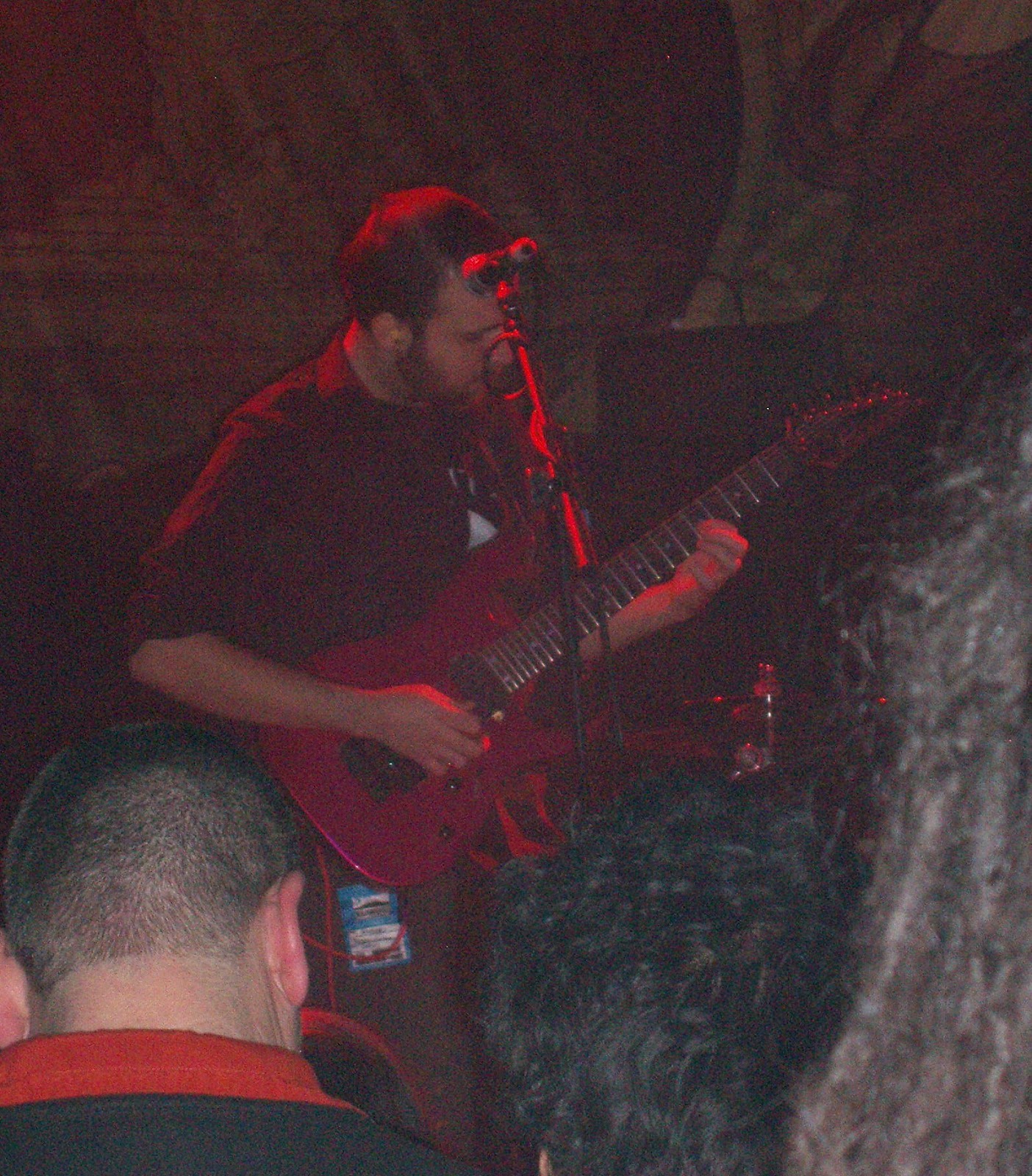 |
| A Chimpspanner |
 |
| He sold his soul |
 |
| Sylosis and shorthairs |
No pain (au chocolat)
 |
| View in cracked mirror |
There was no bath but the shower worked. The TV channels were all in foreign languages; the beer glasses were a thin plastic. The room was not very warm, though the heating was set to maximum; there was snow on the ground outside, which may explain this. I was woken at 4am by drunken people shouting from the street below, shortly followed by rubbish collecting vans, and did not get much more sleep. Descending for breakfast I found that the elevator did in fact work, it was just that the summoning light did not illuminate. For breakfast there was self-service with several pieces of not terribly fresh bread, one type of cheese and small packages of jam, with coffee and tea. There were no croissants or pain au chocolats. But for that, I would stay again, at least during the financial crisis.
Subscribe to:
Posts (Atom)